
Why Does My Child Repeat My Question Instead of Answering It?
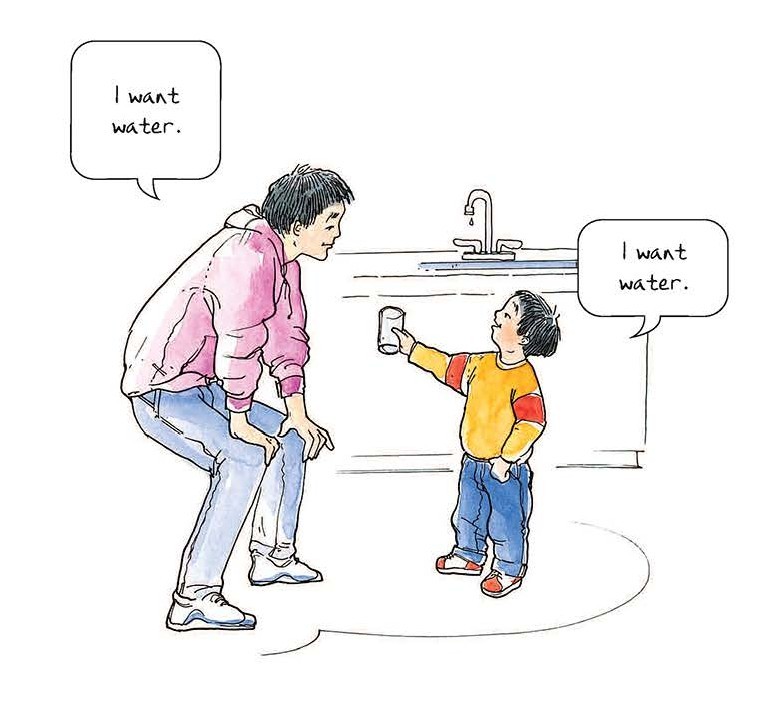
Have you ever asked your child a question, such as “What do you want?”, and he/she responds with “What do you want?” instead of answering your question? This is called echolalia, which occurs when a child repeats another person’s message. There are different types of echolalia, theories about why children demonstrate echolalia, and suggestions for responding to your child in these situations.
There are two main types of echolalia: immediate and delayed. Immediate echolalia occurs when a child repeats a message he/she heard seconds ago. For example, the parent may ask, “What are you doing?” and the child immediately repeats back “What are you doing?” instead of answering the question. Delayed echolalia occurs when a child repeats a message he/she heard after a lapse of time. For example, the child may repeat back “What are you doing?” later that night out of context or even the following week randomly.
“Why does my child repeat my question instead of answering it?” Echolalia is often associated with children who are diagnosed with autism spectrum disorder. There are many functions of echolalia, including: allowing extra processing time, serving as turn taking in conversation, buying time to formulate a response, communicating when using language is difficult, helping to process meaning, rehearsing for future interactions, helping to memorize information, and assisting with self-regulation. Echolalia is not meaningless!
Typically, echolalia decreases as communication skills increase. Strategies to reduce echolalia include using visual cues, prompting with correct responses, modeling with a partner, providing choices, and avoiding complex language by using simple words. Provide a model immediately after asking a question, and then repeat the question to see if you can get an independent answer the second time. The conversation may look something like this:

Parent: What do you want?
Parent: (interrupts before child can repeat) Bubbles! (while holding bubbles for visual cue)
Parent: What do you want?
Child: Bubbles!
In this example, if the child needs an additional cue, the parent may try giving a partial cue such as “buh” for “bubbles.” The parent should expect this to take time and require many opportunities to practice. Ask your child’s speech language pathologist for ways you can help your child with his/her echolalia.
About the Author: Alison Rollins, M.S., CCC-SLP
